Supporting personalized career exploration with AI
How we built an AI-powered tool to help job seekers find new careers based on their goals
Background: While Indeed supported job discovery, it lacked the career guidance that job seekers needed to self actualize and achieve their goals.
Problem: Job seekers feel unsure as to how to grow in their careers. From new grads, to career switchers, to people looking to advance in their current role, users lacked guidance on how their experience translates to different roles.
Solution: Create an AI-powered career career quiz that leveraged job seeker’s resumes to suggest career trajectories, show qualification overlaps, and suggest learning plans.
My involvement: Led AI-driven product innovation by creating and training models that powered a career quiz, personalized recommendations, action plans, and seamless integration into Indeed’s AI chatbot. Partnered with Data Science and Engineering to design prompts, evaluation rubrics, and scalable workflows, improving output quality and extending usability across multiple product experiences. Directed the information architecture to ensure content and guidance surfaced contextually, supporting timely job-seeker decision-making. Collaborated on visual design and drove all content strategy, establishing consistent voice, structure, and semantics across the experience.
Metrics and results: Weekly unique sessions scaled from 2K to 100K (OKR goal), 80%+ of job seekers clicking career details, quiz start ratio up +3.2% overall and +450% for low-profile users, meaningful engagement actions up +4.28%, and LLM suggestion quality consistently passing rubric at 80–87%, with ongoing A/B tests and push notification campaigns sustaining high engagement and diversified visitor sources.
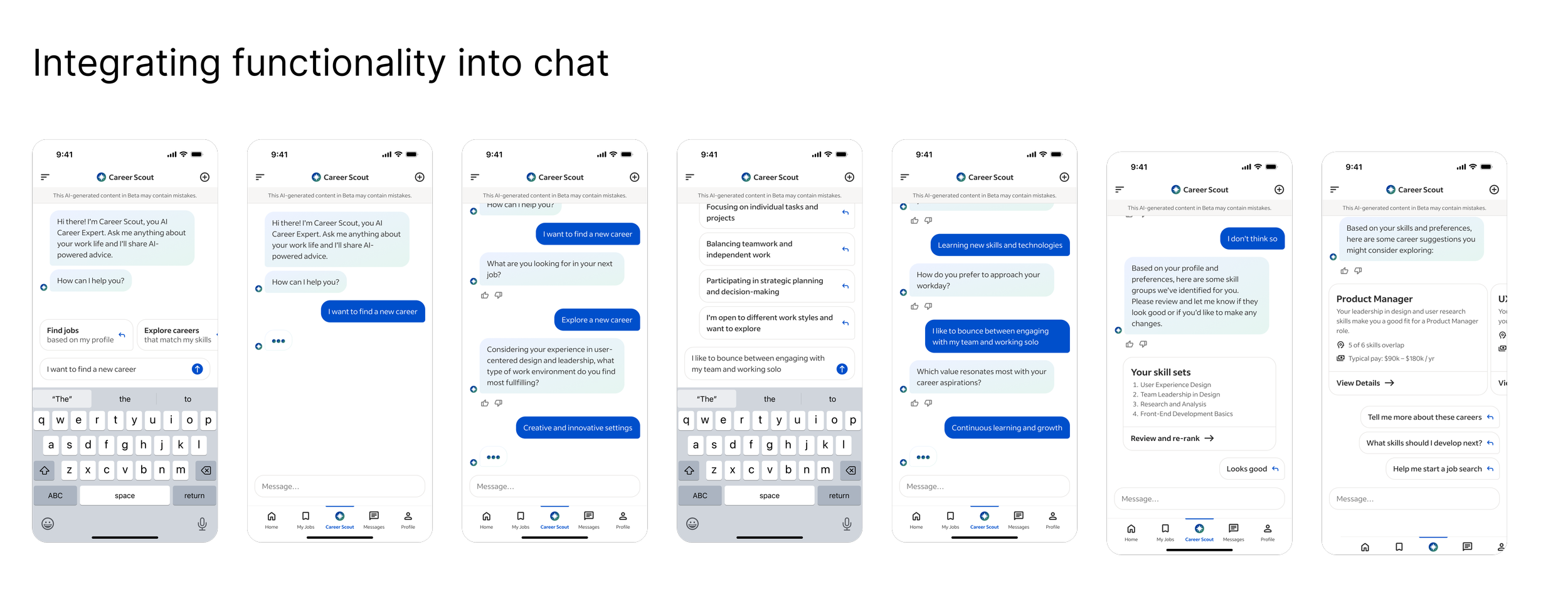
Led UX/AI strategy for integration, writing prompt, personas, and rubrics. Led evaluation efforts to make model iterations following a series of bug bashes.
Creating an AI Interview Prep Experience
How we built an AI-powered solution to help job seekers practice for upcoming interviews.
Background: As part of our suite of AI-driven experiences, we wanted to create a mock interview experience to help job seekers build confidence and prepare for upcoming interviews. In this experience, an AI agent guides job seekers through personalized, role-specific interviews, offering hands-on support for our users.
Problem: Job seekers often struggle to prepare for interviews, especially when it comes to role-specific questions and high-stakes screeners. Many lack access to personalized guidance, leading to a mismatch between their interview performance and the expectations of hiring managers. While we offered coaching, these services were too costly for many job seekers.
Solution: Leverage our AI tooling to offer job seekers personalized support leading up to their interviews.
My involvement: Partnered with Product to define the initial proposal and strategy for an AI-powered interview prep experience, shaping question and feedback types and securing stakeholder and senior leadership alignment. Led prompt engineering, fine-tuning, rubric development, and ongoing model evaluation to improve output quality. Created wireframes to guide early design concepts and collaborated closely with UX Design to refine and evolve the experience
Metrics and results: Completion rate (35%), user-reported confidence uplift (65% gave a rating of 4/5 or 5/5), number of job seekers with a scheduled interview completing at least one mock interview (67%), percentage of users completing more than one mock interview (24%).

Content models for defining (1) our question types and (2) our feedback types. These models were then translated into prompts for our LLM and early iterations of our designs.
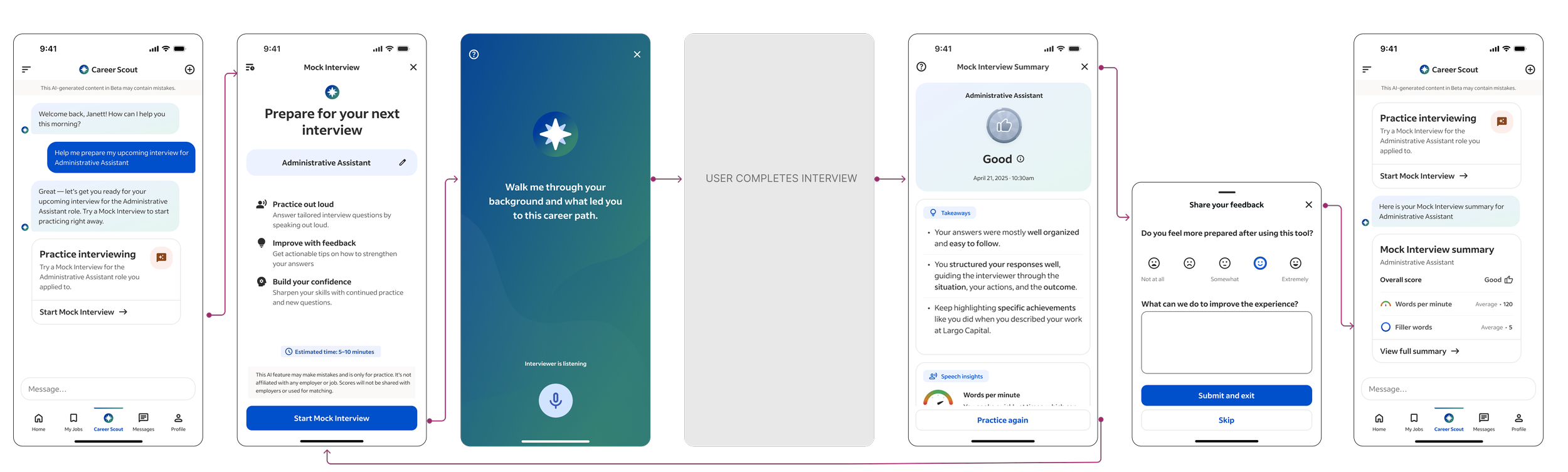
The finalized designs and “happy path” flow
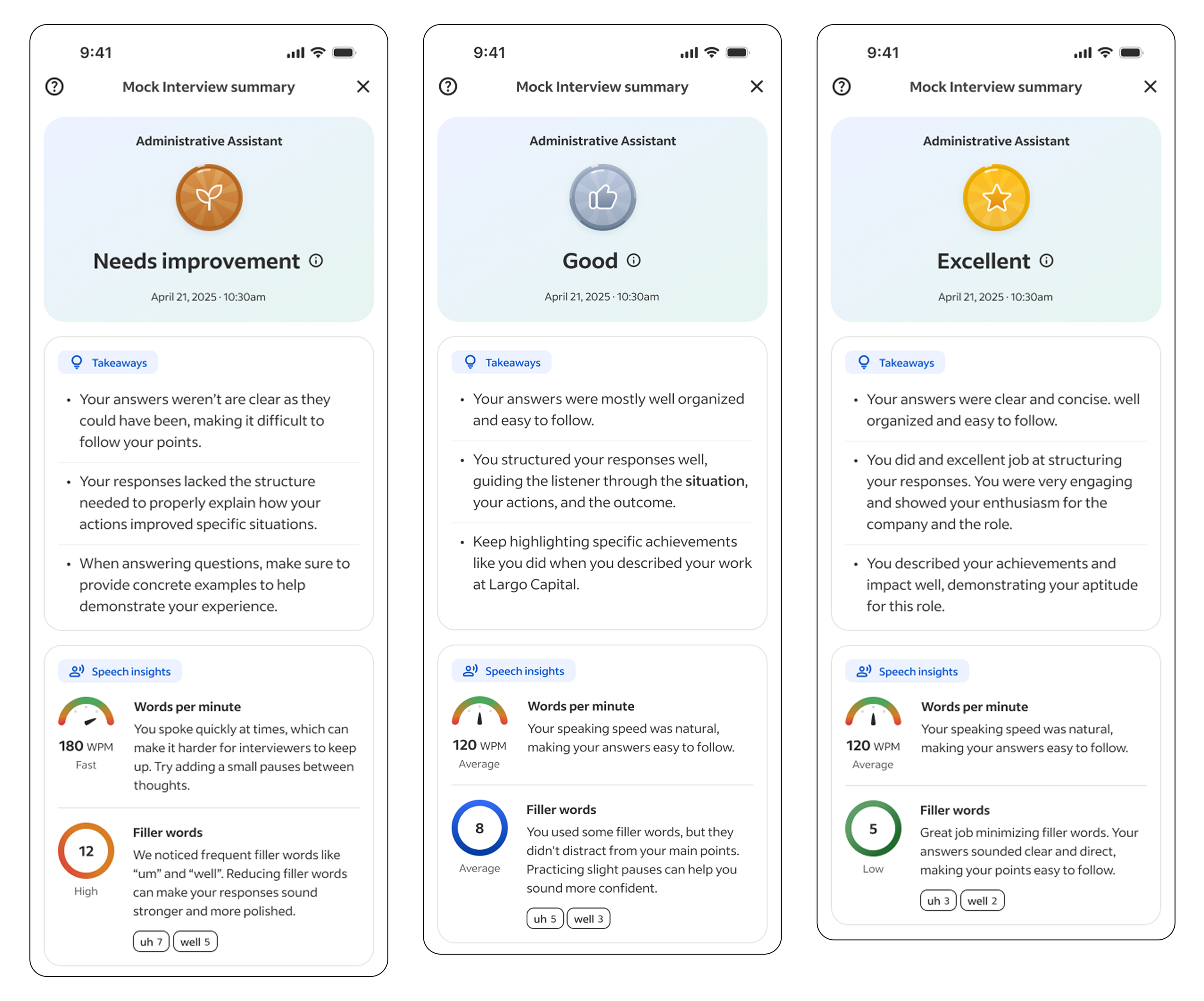
Job seekers could score one of 3 possible ratings for their practice interview: “Needs improvement”, “Good”, and “Excellent”
Monetizing the job-seeker experience
How we created a valuable subscription model while upholding the integrity of the free experience
Background: Representing an opportunity to diversify Indeed’s revenue stream by unlocking new value for job seekers, Pro is a 0 → 1 initiative designed to give job seekers access to exclusive features that help them build confidence, stand out, and save time.
Problem: Job seekers face persistent challenges in their job search, including application overload, uncertainty about how to present themselves effectively, and a lack of feedback after applying. Even with enhancements to our core product, these frustrations remain inherent to the job-seeking experience.
Solution: Offer highly motivated job seekers a paid subscription model (while testing freemium/free trial strategies) to help them save time and maximize their chances of success.
My involvement: Developed feature and value-packaging strategy in partnership with Product and UXR, leading cross-functional workshops to define scope and align priorities. Partnered with UX Design on UI direction and implemented freemium strategies with targeted upsells to drive conversion. Directed UXR studies on feature naming, ran growth experiments to optimize key metrics, and collaborated with Product Marketing on go-to-market plans to ensure consistent positioning and adoption
Metrics and results: Subscribers (15K+), free trial to paid conversion (43.5%), month 2 retention (30%), higher-income job seekers converting 21% more than <$60K segment, top choice and top applicant feed features driving +40% profile optimization and +28% employer response, with 3x top-of-funnel traffic sustaining a stable 41% conversion.
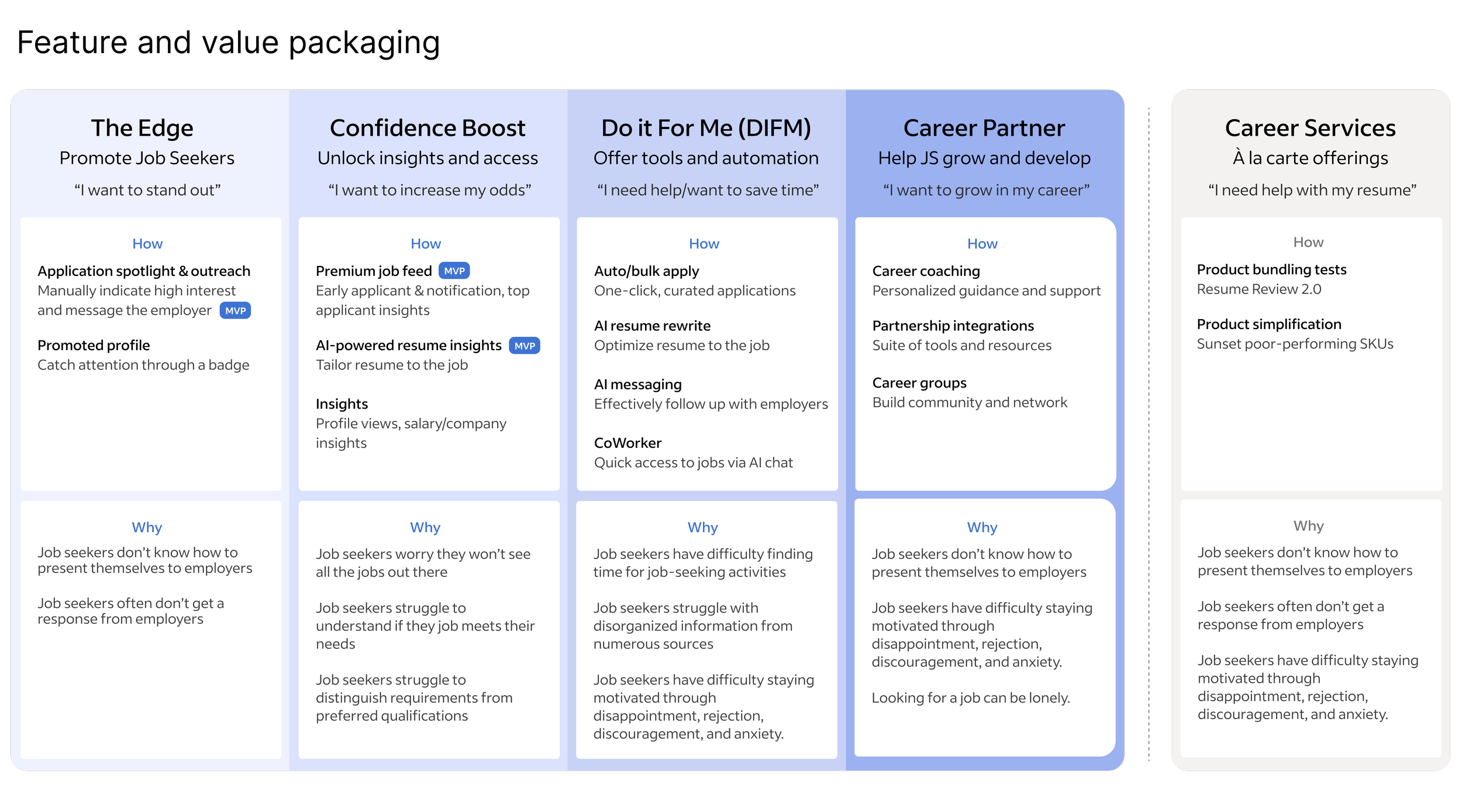
Content model I created to lead monetized Product strategy and get alignment with leadership.
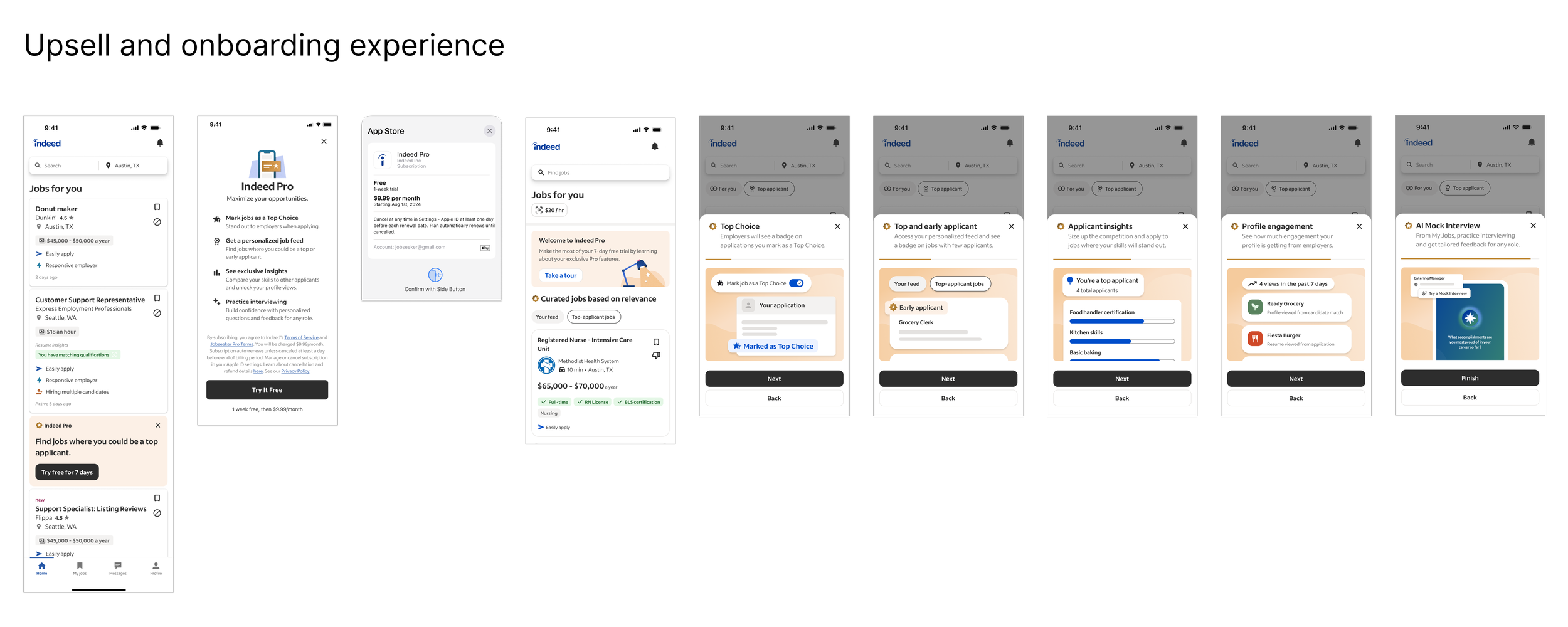
Happy path showing contextual upsell for Pro in job feed, paywall screen, and onboarding flow once subscribed.
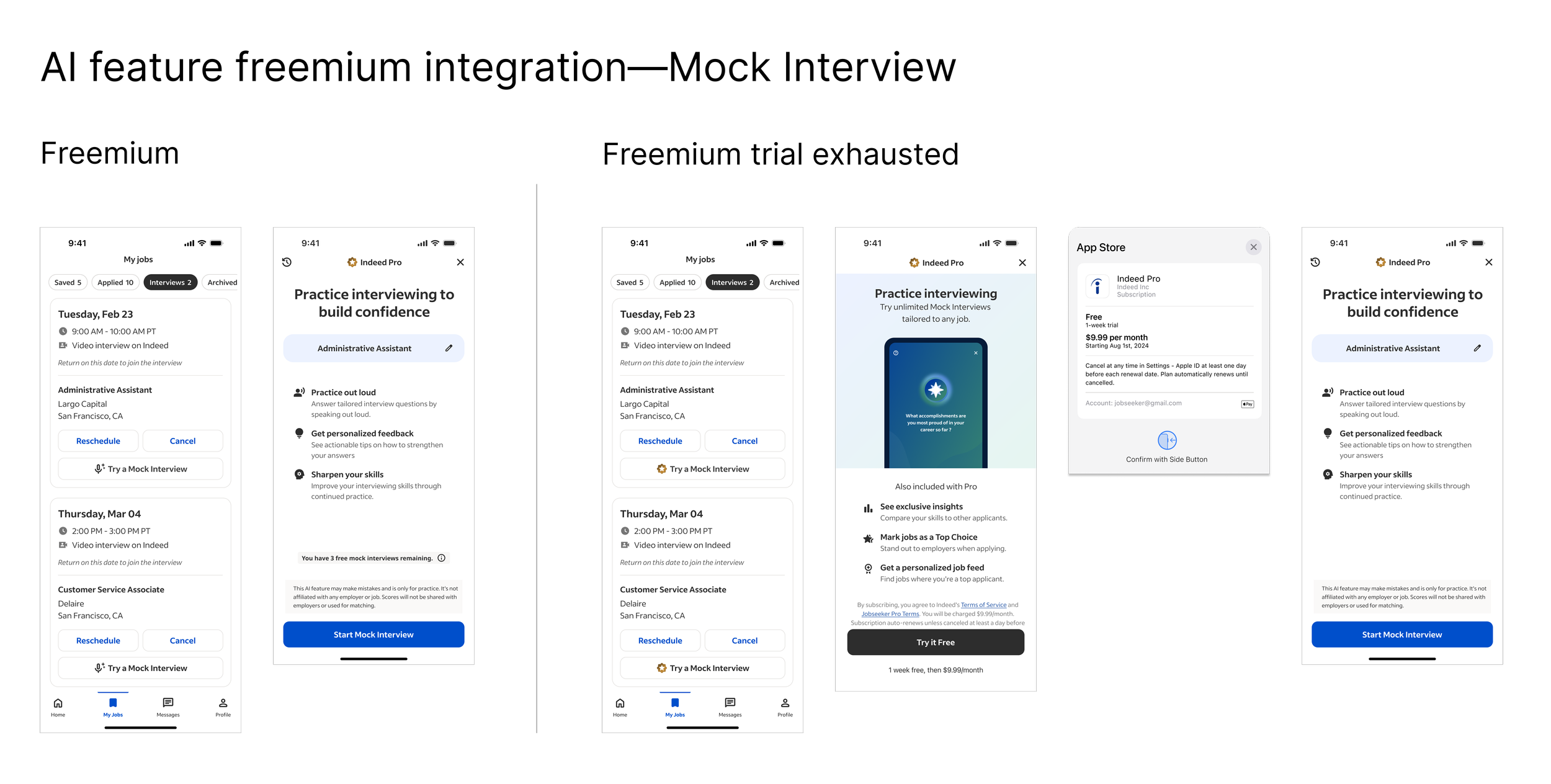
A look at how we communicate freemium trials before subscription and how the UI changes to encourage subscription once trials have been exhausted.
Redefining our information hierarchy for job postings
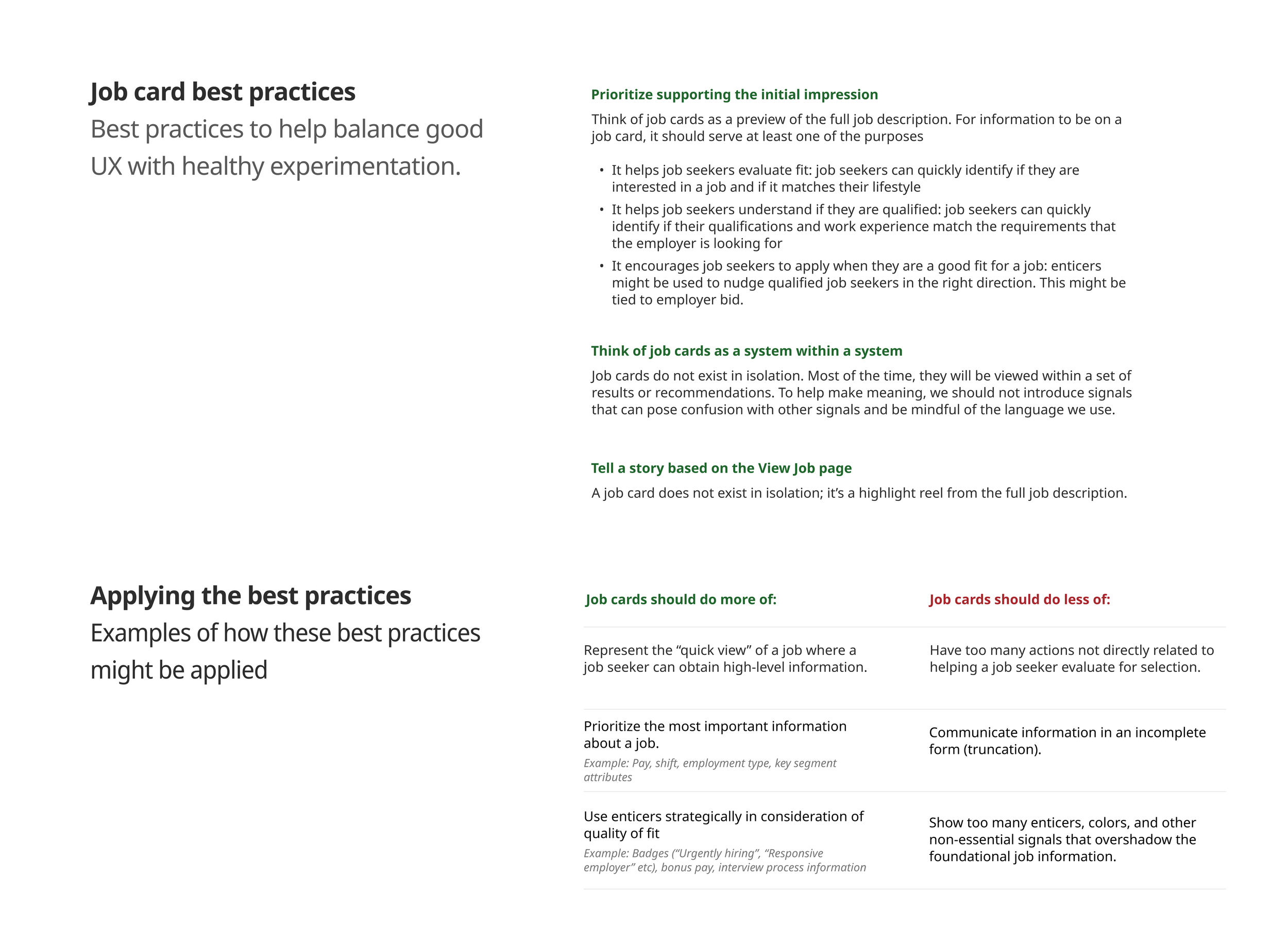
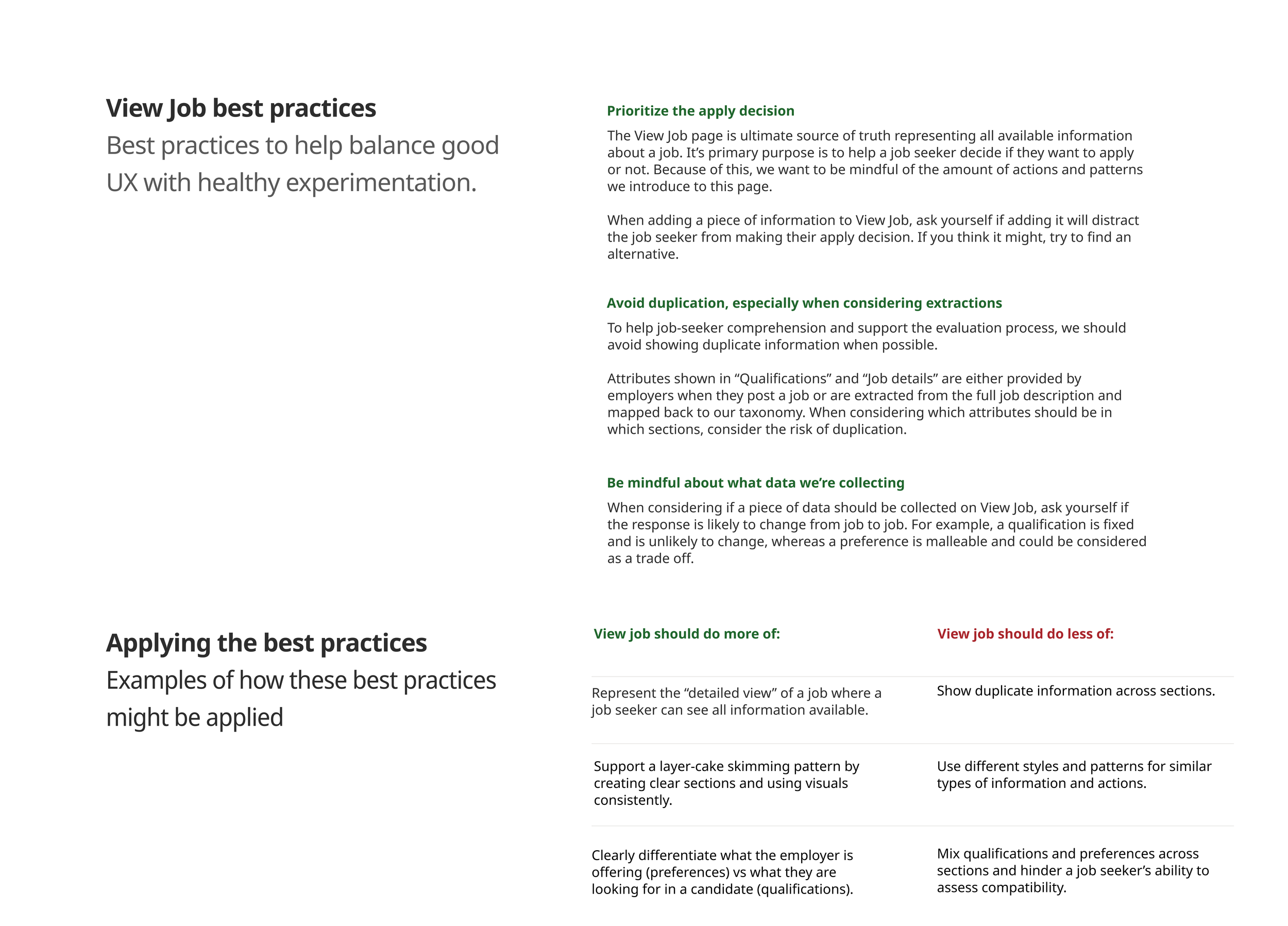
How we created a research-backed framework to help teams experiment while upholding a consistent user experience
Background: Job descriptions are a pivotal part of the Indeed experience. Job seekers need to compare jobs across discovery surfaces and make informed apply decisions based on compatibility. On Indeed, job descriptions show up in one of two ways: as a preview (job cards), or as a complete description (view job).
Problem: Because of the importance of job cards and view-job pages, many teams across the company ask to run experiments these surfaces. But a lack of guidance and flexibility within our current system was creating an unpredictable experience for job seekers and a confusing experiment approval process for product teams.
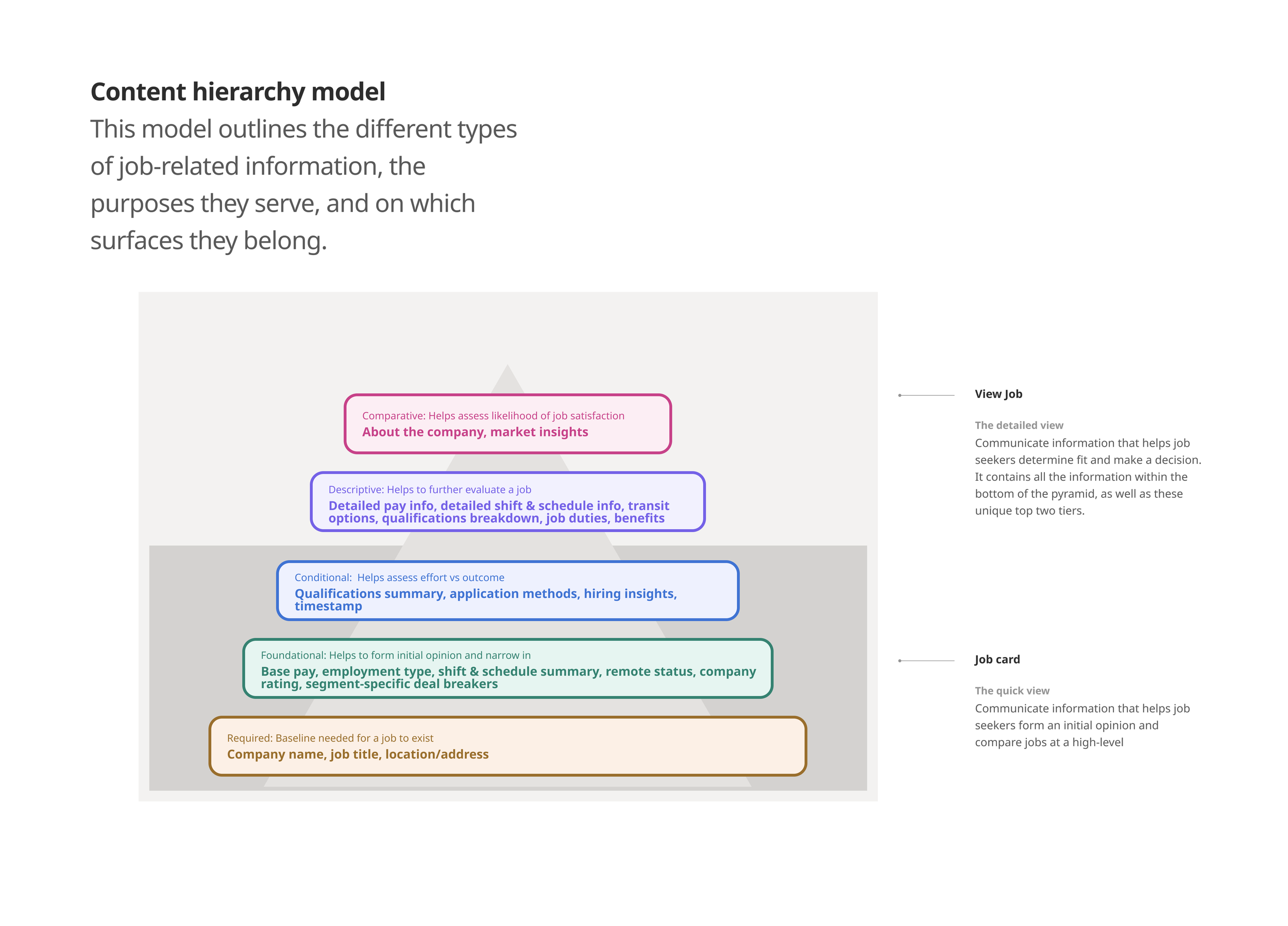
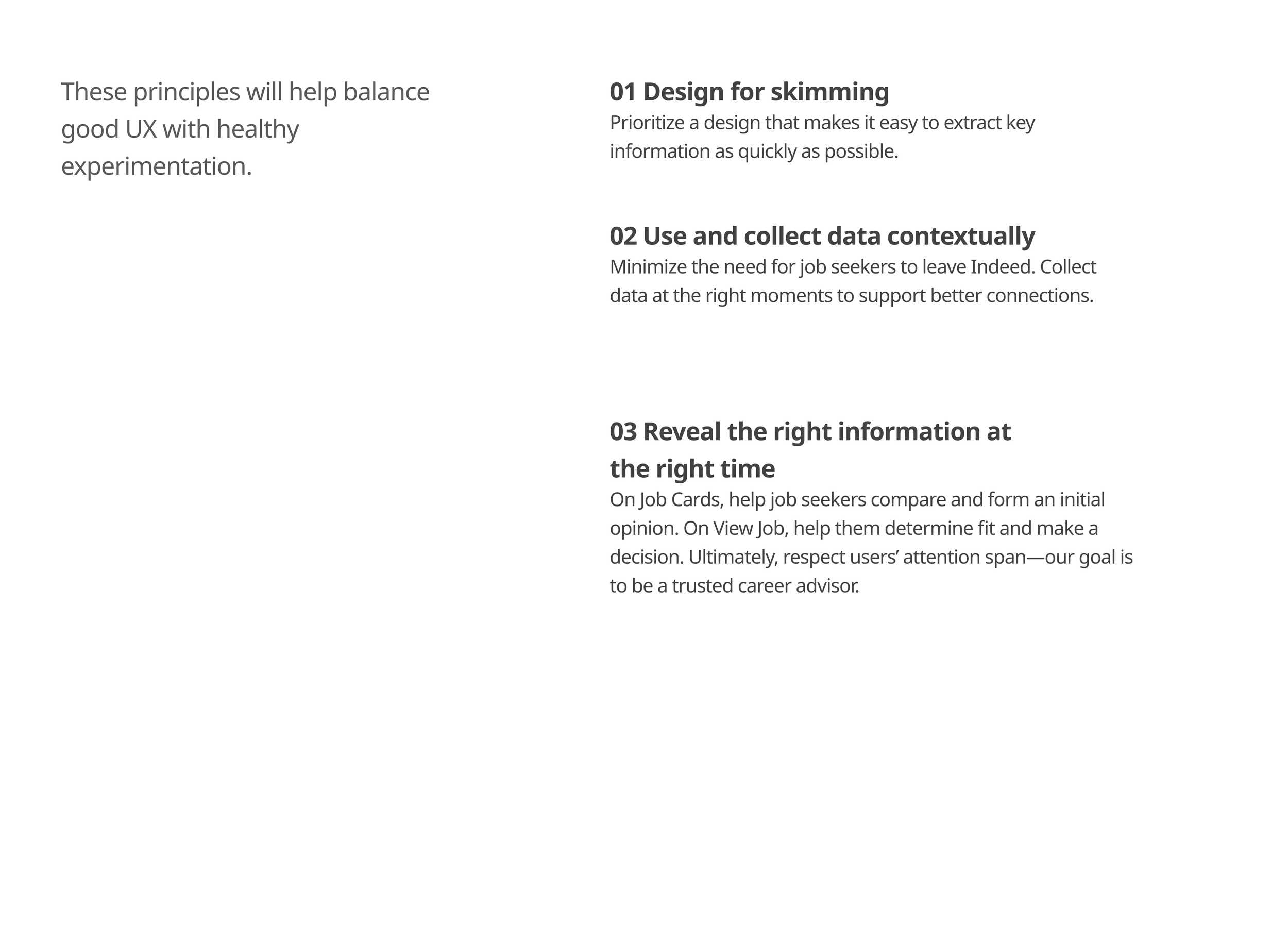
Solution: To address this issue, we created guidance around which pieces of information belong on which surfaces. Forming our hypotheses based on prior research and experiments, we created a content model to enable teams to make quick decisions. This model was tested in research and resulted in a set of best practices for design and experimentation on job cards and view-job pages.
My involvement: Identified the need for a new system, got buy-in from UX and Product leaders, created the content model and iterated on it based on feedback, identified need for research to validate our assumptions, kept our resources up-to-date, lead product conversations around experimentation opportunities, provided guidance to other teams to make informed product decisions based on our framework.
Creating a dynamic display system for jobs
How we personalized the job-discovery experience to support job seekers and employers
Background: Helping employers attract high-quality candidates is an top priority for Indeed. As part of our sponsored product, our team needed to find ways to help sponsored jobs garner more attention from candidates. While all job descriptions are comprised of foundational information (title, pay, location, employment type), there are enticers that help to support job evaluation and the application process. Our team wanted to optimize this information and show it in the right moments to the right job seekers.
Problem: While we recognized the importance of this type of supplemental information, we lacked a systemic approach for how different types of information should manifest on a job description based on level of sponsorship and quality of fit. This was resulting in information overload on our job cards and a lack of thoughtful IA to help job seekers make informed decisions. It also meant that our sponsored product was not optimized to its full extend. We needed to increase the value of our product offering to acquire more sponsored employers.
Solution: We adopted a systemic lens for different types of information, focusing in particular on what we called “supplemental information”—all that is not critical for a job description, but that entices job seekers to engage with a job. To help us determine which pieces of supplemental should show on job cards in which moments, we created a content model. This model then allowed us to create a series of experiments to test our hypotheses about supplemental information.
My involvement: Identified opportunity to leverage supplemental information as part of our sponsored strategy, categorized and defined existing job information based on current system, created content model based on data-informed hypotheses and Product feedback, lead experimentation strategy and scoping conversations to help validate our hypotheses, created wireframes to help guide design direction.

Increasing engagement with strong-match jobs
How we designed a full-screen takeover on mobile to help users find their next job
Background: The Indeed feed presents job seekers with a list of job recommendations based on their profile and behaviour. But within this list, some jobs are a stronger match than others. To help bring these strong-match jobs to the surface, we wanted to explore a one-at-a-time experience that would take over the entire screen on mobile devices, similar to content patterns seen social media products.
Problem: Strong-match jobs were getting lost in the user’s feed, resulting is less engagement with jobs that users were more likely to get.
Solution: Driving inspiration from social media products, we created a one-job-at-a-time experience that would take over the entire viewport. Allowing users to spend more time evaluation individual jobs that match their profile, we hypothesized that this feature would help increase the likelihood of job seekers hearing back from employers.
My involvement: Leveraged content hierarchy model (shown above) to guide design decisions, lead UX decisions, provided directional guidance on the information architecture and match signals, advocated to testing several variants to find the ideal content hierarchy, define Research scope in close collaboration with UXR.
